

Updated November 2026
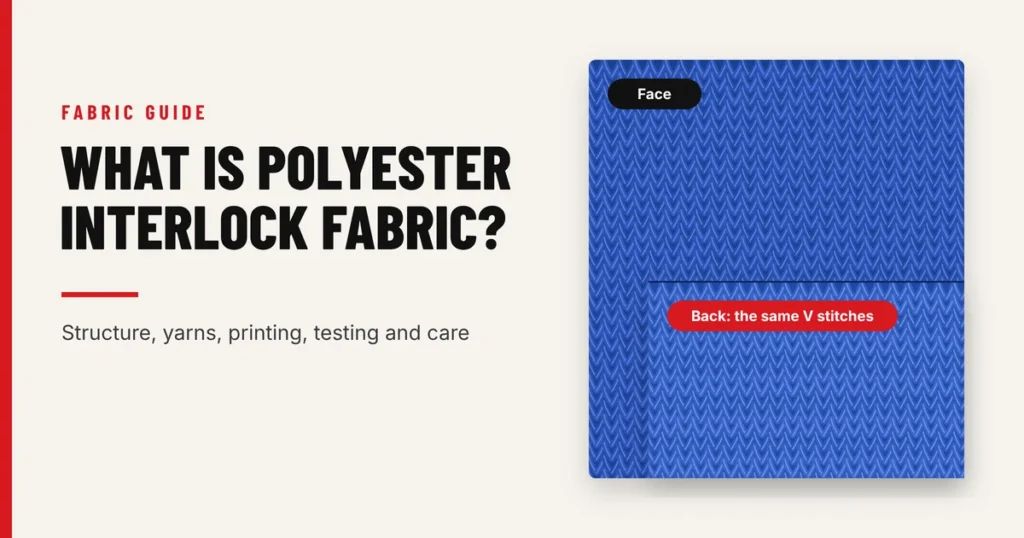
Take a knit shirt and look at the inside. If the inside looks just like the outside, smooth on both sides, you may be holding an interlock.
Now check the label. If it says 100% polyester, it is very likely polyester interlock fabric, one of the most used knits in sportswear, school uniforms and printed team kits.
Two rolls sold under the same name can still behave very differently. Yarn, weight, finishing and dyeing decide whether a garment stays bright and flat, or snags, twists and loses its print.
This guide explains each of those choices with sources you can check.
In this guide
- The Short Answer
- What Interlock Actually Is
- Where Interlock Came From
- Interlock vs Single Jersey vs Rib vs Mesh
- Inside the Yarn: Denier, Filaments and Lustre
- How Polyester Moves Sweat
- Choosing the Weight
- Heat Setting: Why Good Polyester Stays Flat
- Printing on Polyester Interlock
- Sewing Polyester Interlock
- Honest Pros and Cons
- Quality Testing: The Standards That Matter
- Certifications for Polyester
- How to Write a Polyester Interlock Spec
- Caring for Polyester Interlock
- Frequently Asked Questions
- The Bottom Line
The Short Answer
- Interlock is a double knit: two 1×1 rib structures joined into one fabric.
- Both sides look the same, the fabric is stable, and the cut edges lie flat.
- Polyester takes up very little water, so it moves sweat by wicking, not by soaking it up.
- White polyester interlock is a common base for dye sublimation printing.
- Quality depends on yarn, heat setting, dyeing and testing, not just on the name.
What Interlock Actually Is
Interlock is made on a double knit machine with two sets of needles: one set in the cylinder and one in the dial.
Cotton Incorporated explains that interlock “gets its name from the ‘interlocking’ of two 1×1 rib fabrics together into one fabric.” In interlock, the cylinder and dial needles are “directly opposed,” and opposing needles are never used in the same cycle.
The result, in Cotton Incorporated’s words, is fabric with “the same appearance on the face and back” that is “very stable” with “no curling.”
That stability has a cost. Cotton Incorporated also notes that interlock is “more rigid and stable than that of a rib,” because the interlocking “prevents adjacent wales from having mobility.”
So polyester interlock fabric does stretch, but less freely than a rib knit.
Two Quick Ways to Spot It
Apparel Search describes two simple checks:
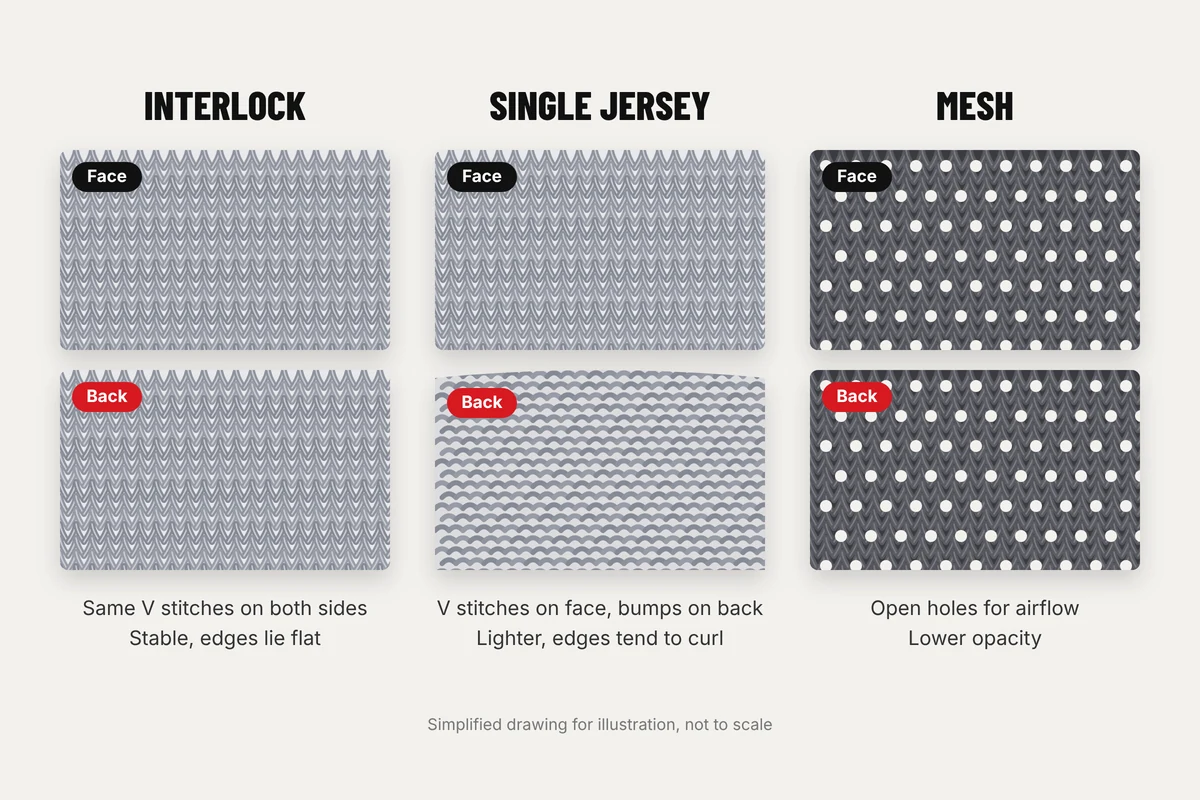
- The back check. Gently stretch the fabric across its width. Interlock looks much the same on both sides. Single jersey shows a different, bumpy pattern on the back.
- The edge check. Cut a small swatch. A single jersey edge tends to curl. An interlock edge lies flatter.
Where Interlock Came From
You will see confident dates and stories about interlock online. Most come without a source, so here is what the record shows.
In September 1908, the US patent office granted Robert W. Scott patent US899439 for a “Ribbed knitted web.” The patent describes two ribbed webs joined together, which is the idea behind interlock.
It covers the fabric and the method, not a named “interlock machine.”
Polyester came later. According to Wikipedia, PET polyester was patented in 1941 by John Rex Whinfield and James Tennant Dickson of the Calico Printers’ Association in Manchester, England.
Interlock vs Single Jersey vs Rib vs Mesh
These four knits are often confused when sportswear is specified.
| Feature | Interlock | Single jersey | 1×1 rib | Mesh (such as birdseye) |
|---|---|---|---|---|
| Needle sets | Two, opposed | One | Two, alternating | Varies by design |
| Face and back | The same | Different | The same | Open pattern |
| Edge curl | Very little | Curls | Very little | Varies |
| Stretch | Moderate, stable | Good | High across the width | Varies |
| Opacity | Higher | Lower at the same yarn | Medium | Lower, has open holes |
| Typical uses | Team shirts, polos, uniform tops, leggings | Light tees, linings | Cuffs, collars, fitted tops | Basketball and running tops |
Apparel Search adds a practical point: interlock “tends to cost more” to produce, because a double knit uses more yarn and slower machine settings.
Inside the Yarn: Denier, Filaments and Lustre
Much performance polyester is made from continuous filament yarn, described with two numbers.
- Denier (D): the weight in grams of 9,000 metres of yarn. A higher number means a heavier yarn.
- Filament count (F): how many single filaments are in the yarn.
So “75D/72F” means a 75 denier yarn made of 72 filaments. Divide one by the other and you get about 1 denier per filament.
That matters because Wikipedia defines microfiber as threads finer than one denier. Microfiber yarns are common in athletic wear because they help wick moisture away from the body.
Why Some Polyester Shines and Some Looks Matte
Polyester’s shine is controlled with a delustrant, usually titanium dioxide, added to the polymer. Wikipedia notes that the amount varies “depending on the level of lustre required,” up to about 2%, and that it reduces the fibre’s transparency.
In the trade, yarns are sold as bright, semi dull or full dull. The exact amounts vary by producer, so ask for the lustre on the spec rather than relying on a photo.
As a rule, duller yarns look more like cotton and help with opacity on white garments. Bright yarns give the classic sheen of a shiny team shirt.
How Polyester Moves Sweat
Polyester takes up very little water. Textile Learner lists the moisture regain of polyester at 0.4%, against 7% to 11% for cotton.
So polyester does not keep you dry by soaking up sweat. It works by wicking: liquid travels along the tiny spaces between fine filaments and spreads out, where it can evaporate.
Two things improve this:
- Finer filaments. More, finer filaments create more small channels for liquid to travel along.
- Shaped filaments. Some yarns are spun with grooved or shaped cross sections. A study on C shaped filament yarn published on Zenodo looks at how such shapes affect wicking in comfort fabrics.
Some fabrics instead rely on a wicking finish applied during dyeing. That can work well, but finishes may not last as long as the fibre shape itself.
The safest step is to ask for wicking test results on your polyester interlock fabric both before and after laundering.
Choosing the Weight
GSM (grams per square metre) is the quickest way to compare fabrics, but it is only part of the story with polyester interlock fabric.
Because interlock is a double knit, it uses more yarn than single jersey made from the same yarn. That is why interlock often feels fuller and more opaque.
Rather than chasing one number, compare samples of polyester interlock fabric for the job:
| If the garment needs to… | Look for |
|---|---|
| Stay cool in hot weather | A lighter weight with fine filament yarn |
| Hide what is underneath, especially in white | A heavier weight or duller yarn |
| Take hard contact and many washes | A heavier, tighter knit and a good snag test result |
| Stretch with the body | Elastane in the blend |
Write the target GSM and a tolerance on your order, and judge the sample in your hand, not just the number on paper.
Heat Setting: Why Good Polyester Stays Flat
Polyester is thermoplastic, which means heat can set the shape of polyester interlock fabric. Heat setting relaxes the tension left from knitting and gives the fabric dimensional stability.
Textile Learner gives a heat setting range for polyester of about 170 to 210°C, and notes that a correctly heat set fabric should show residual shrinkage “of less than 1%” on a five minute boiling water test.
For buyers, the lesson is simple: ask whether the fabric is heat set, and back it up with a shrinkage test after washing.
Printing on Polyester Interlock
Dye Sublimation
White polyester interlock fabric is one of the most common bases for dye sublimation. Heat turns the ink into a gas that bonds with the polyester fibres, so the print becomes part of the fabric.
Sawgrass, a sublimation ink maker, lists 45 seconds at 400°F (205°C) as its starting press setting for polyester fabric. Always confirm settings with your own ink and press.
Sublimation needs polyester and a white or very light base. For a full guide, see our article on custom sublimated jerseys for teams.
Printing on Dyed Polyester: Watch for Dye Migration
Printing a white logo on a dark polyester shirt brings a different risk: dye migration. The fabric’s own dye can move into the ink and turn white prints pink or grey.
PRINTING United Alliance explains that most polyester dyes used in T-shirts and fleece hold up to about 182°C (360°F). Above that, the dye can turn to gas and move into the ink.
Its advice includes:
- Use inks with dye blocking agents made for polyester.
- Keep flash units from overheating the fabric.
- Make sure the whole ink film cures properly.
- Print test each new lot of ink and fabric.
On the mill side, dark polyester is usually given an after wash called reduction clearing to remove loose dye from the fibre surface. Ask whether this was done for dark colours.

Sewing Polyester Interlock
Polyester interlock fabric is pleasant to sew because it is stable and does not curl. A few habits prevent most seam problems:
- Use a ballpoint needle. Groz-Beckert’s SES light ball point is recommended for “fine to medium knitwear.” It pushes the yarns apart instead of cutting them.
- Use stretch seams. An overlock (serger) for main seams and a coverstitch for hems let seams move with the fabric.
- Watch the tension. Too much thread tension can make smooth knits pucker along the seam.
- Press gently. Polyester softens with heat, so press from the back at a low setting.
Honest Pros and Cons
| Pros | Cons |
|---|---|
| Same smooth surface on both sides | Less stretch than a rib knit |
| Stable, with edges that lie flat when cut | Uses more yarn, so it tends to cost more than single jersey |
| Good opacity, helpful for white kits | Low moisture uptake can feel clammy if the yarn is coarse |
| Excellent base for sublimation printing | Fine filaments can snag on Velcro or rough gear |
| Low shrinkage once properly heat set | High heat can glaze or mark the surface |
Quality Testing: The Standards That Matter
Claims such as “quick dry” or “snag resistant” mean little without a test. These standard methods cover the main risks for polyester interlock fabric:
| What is tested | Standard | Why it matters |
|---|---|---|
| Moisture management | AATCC TM195 | How liquid moves through and spreads across the fabric |
| Wicking after washing | AATCC 197 or 213, after laundering | Shows whether wicking lasts |
| Drying rate | AATCC 201 (heated plate) | How quickly the fabric dries |
| Snagging | ASTM D3939 (mace test) | How easily filaments are pulled out |
| Bursting strength | ASTM D3786, ISO 13938-1 | Strength of the knit, which has no warp and weft |
| Shrinkage | AATCC 135, or ISO 6330 with ISO 5077 | Change in size after washing |
| Colour fastness to dry heat | ISO 105-P01, AATCC TM117 | Whether dye moves under heat, important for printing |
| Colour fastness to perspiration | ISO 105-E04 | Dye bleeding with sweat |
| Pilling | ASTM D3512, ISO 12945-2 | How quickly pills form |
Pass levels are not set by the methods themselves. Agree them with your supplier and write them into the order.
Certifications for Polyester
- GRS (Global Recycled Standard): Textile Exchange says the GRS can be used business to business for products with at least 20% recycled content. Consumer facing GRS labels need at least 50%.
- RCS (Recycled Claim Standard): IDFL notes the RCS is meant for products with at least 5% recycled material.
- OEKO-TEX STANDARD 100: tests products for substances harmful to health. Hohenstein, an OEKO-TEX institute, makes clear it is not an environmental claim.
Ask for the certificate or transaction certificate number and check it with the issuer. For more on recycled fibres, read our guide to recycled polyester sportswear.
How to Write a Polyester Interlock Spec
Before you order polyester interlock fabric or garments made from it, write down:
- Fibre content, for example 100% polyester or polyester with elastane.
- Construction: interlock.
- Yarn: denier, filament count and lustre.
- Target GSM with a tolerance.
- Usable width.
- Colour reference and lab dip approval.
- Finishes, such as wicking or anti odour, and how long they must last.
- Heat setting and a maximum shrinkage after washing.
- Test methods and pass levels from the table above.
- Any certification needed.
Then ask for a sample. Wash it, stretch it and, if you plan to print, press a test print on it before you approve bulk.
Caring for Polyester Interlock
- Wash cool or warm, on a normal or gentle cycle.
- Many sportswear makers advise skipping fabric softener, as it can leave a coating on the fibres.
- Tumble dry low or hang to dry.
- Iron only if needed, on a low setting and from the back.
- Close zips and Velcro before washing to protect the surface from snags.
Why low heat? Wikipedia gives polyester (PET) a glass transition around 67 to 81°C and a melting point above 250°C. Long before it melts, too much heat can mark or glaze the surface.
Frequently Asked Questions
These are the questions people ask most about polyester interlock fabric.
Is polyester interlock breathable?
It can be. Polyester takes up very little water, so comfort depends on wicking. Fine filament yarns and a lighter weight help. For maximum airflow, a mesh may suit better.
What is the difference between interlock and single jersey?
Single jersey uses one set of needles. It is lighter and curls at the edges, with a different look on the back.
Interlock uses two opposed sets of needles. It is the same on both sides, more stable and more opaque.
Is interlock stretchy?
It has some stretch, but less than a rib knit. Cotton Incorporated describes interlock as more rigid and stable than rib. Elastane adds stretch when a garment needs it.
Does polyester interlock shrink?
Properly heat set polyester shrinks very little. Textile Learner’s benchmark for a correctly heat set fabric is less than 1% shrinkage in a boiling water test. Ask for a wash test to confirm.
Why did my white print turn pink on a dark polyester shirt?
That is dye migration. Heat during printing or curing can move the fabric’s dye into the ink. Dye blocking inks, controlled heat and test prints reduce the risk.
Can you sublimate on polyester interlock?
Yes, on white or very light polyester. Sublimation does not work on cotton, and it does not show well on dark fabric.
Which needle should I use?
A ballpoint needle made for knits, such as a light ball point (SES) for fine to medium knitwear.
Is interlock more expensive than single jersey?
It usually is. A double knit uses more yarn and slower machine settings, so it tends to cost more to produce.
The Bottom Line
Polyester interlock fabric earns its place in sportswear because it is stable, opaque, flat and easy to print. But the name alone guarantees none of that.
Ask for the yarn, lustre, weight, heat setting and test results. Then test a sample yourself before bulk. That is how you get the fabric you expected.
Related guides: what is French terry fabric, custom team tracksuits and why clubs are switching to sublimated team kits.
About this guide
Written by Hamasah Tayyaba and reviewed by Muhammad Abdullah Hamas. Every fact in this guide is linked to the source it came from below. If you spot an error, tell us and we will correct it.
Sources
- Cotton Incorporated, Double Knits
- Apparel Search, Jersey vs Interlock Fabric
- Google Patents, US899439A, Ribbed knitted web (Robert W. Scott, 1908)
- Wikipedia, Polyethylene terephthalate
- Wikipedia, Microfiber
- Wikipedia, Delustrant
- Textile Learner, Moisture Regain of Fibers and Heat Setting Process
- Zenodo, Wicking Performance of C-Shape Filament Yarn for Comfort Fabrics
- Sawgrass, Sublimation Heat Press Settings
- PRINTING United Alliance, Controlling Synthetic Polyester Dye Sublimation and Migration
- Groz-Beckert via College Sewing, SES Light Ball Point Needles
- AATCC, 2025 Technical Manual Changes
- Manufacturing Solutions Center, Moisture Management Testing
- ASTM International, D3939 Snagging Resistance of Fabrics (Mace)
- Textile Exchange, RCS and GRS
- Hohenstein, OEKO-TEX STANDARD 100 FAQ
- IDFL, Recycled Claim Standard
