


Updated November 2026
Amateur clubs rarely buy kit the way professional sides do. There is no kit manager and no multi-year supplier deal.
There is usually one committee member with a spreadsheet, a squad that changes every few months, and a first fixture that is closer than anyone admits. This guide is written for that person.
Buying rugby kits for amateur clubs comes down to four decisions: what goes in the order, how it is built, how many pieces you need, and who makes it.
Get those right and the kit survives a season of contact. Get them wrong and you are reordering by November.
What the Laws Actually Require
Start with the rules, because they are short. World Rugby’s Law 4 on permitted clothing says a player wears a jersey, shorts and underwear, socks and boots.
The same law says a jersey sleeve must reach at least halfway from the shoulder point to the elbow. All clothing must meet Regulation 12, and World Rugby recommends that every player wears a mouthguard.
That is the legal minimum. Everything else comes from your league, your budget and how hard your squad plays.
What Goes in the Order
For most amateur sides, an order for rugby kits for amateur clubs splits into four groups. Ordering them in this sequence keeps the budget under control.
| Group | Items | When to buy |
|---|---|---|
| Match kit | Jersey, shorts and socks in one design | First, before the season |
| Training kit | Lighter shirts for midweek sessions | First order or the next one |
| Extras | Warm-up tops, jackets, hoodies, caps | Once the match kit is paid for |
| Player-bought | Boots and mouthguards | Each player, for their own fit |
Ordering jersey, shorts and socks together matters more than it sounds. Made from one design file, the colours and logos line up across the whole kit.
Matching sports socks and tracksuits for warm-ups can come later. If money is tight, the match kit goes first.
Fabric and Construction: Where Rugby Kit Fails
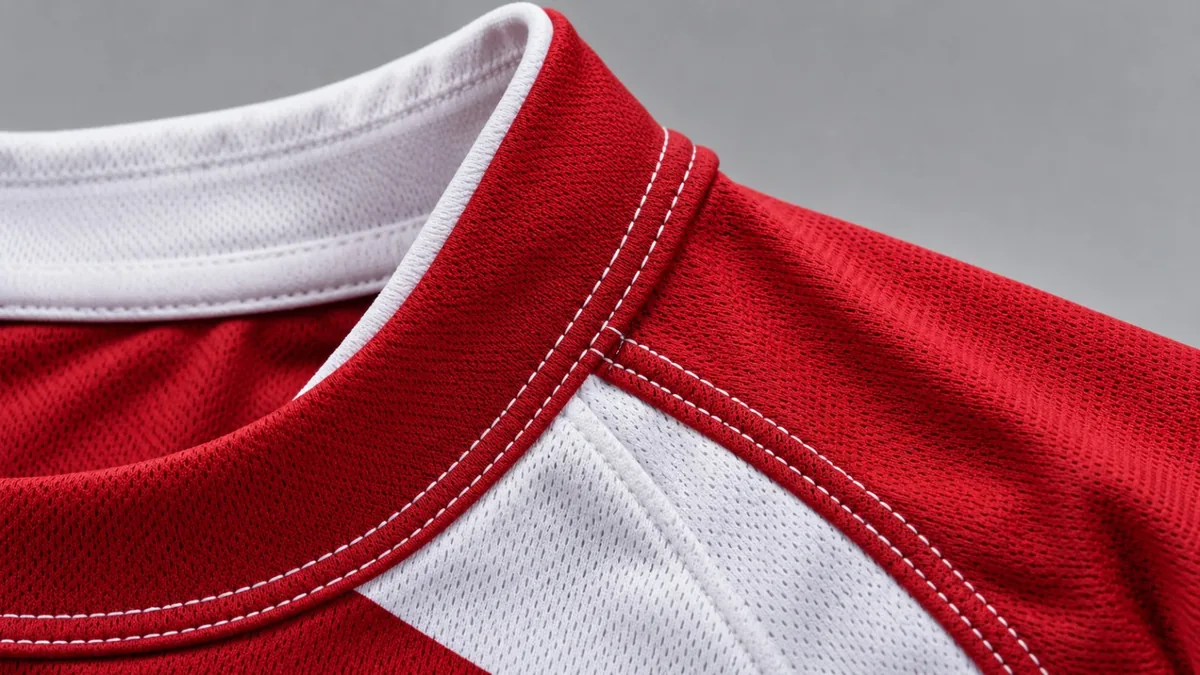
Rugby is hard on jerseys because opponents hold on to them. The collar, shoulders and side seams take most of the strain, so check those first.
- Performance polyester: light, quick drying and holds colour well. Most sublimated kits use it.
- Reinforced stitching: ask exactly where it sits. Double or triple stitching at the collar, shoulders and side seams is what you want.
- Some stretch: a polyester and elastane blend moves with the body and recovers after a tackle. Raise it early, because it can change the price.
- The right cut: a slim fit leaves less fabric to grab. A regular fit is kinder to a squad of mixed shapes and sizes.
When you compare quotes for rugby kits for amateur clubs, ask for photos of finished collars and seams from a past rugby order. A design mockup shows the colours, not the build quality.
Our Custom Rugby Uniforms page shows how a manufacturer-direct order is put together.
Sublimation or Cut-and-Sew?
Clubs often see both terms in the same quote, and they are not rivals. Sublimation is how the design gets onto the fabric. Cut-and-sew is how the garment is built.
| Sublimation | Classic cut-and-sew | |
|---|---|---|
| How it works | The design is dyed into polyester fabric | Colour panels are cut from dyed fabric and stitched together |
| Design freedom | Any pattern, any number of colours | Best for hoops, panels and solid blocks |
| Durability of the design | Will not crack or peel like an applied print | Stitched panels last, applied prints can wear |
| Watch for | Colours can look different on fabric than on screen | More seams, more cost per design |
Many modern kits combine the two: a cut-and-sew body for strength, with a sublimated pattern on top. For most amateur squads, sublimation is the sensible default because extra colours and sponsor logos add little cost.

See what a performance jersey range looks like in our High Quality Rugby Uniforms, or read more about sublimated team kits.
Sizing a Squad That Keeps Changing
Sizing needs the most planning in rugby kits for amateur clubs, because amateur squads grow and shrink. New players turn up in week three, juniors move up an age group, and the women’s side wants the same design as the men’s.
Plan for that from the start:
- Measure real players. Take chest and body length for each person. Everyday T-shirt sizes are not reliable for a rugby cut.
- Try a sample. Check the size chart and get a sample set so players can test the fit in training.
- Order women’s and junior cuts. World Rugby’s squad kit guidance calls kit cut for female players essential. It also notes that most women’s teams have moved to dark shorts.
- Keep a size record. One sheet with each player’s name, number and size makes the next order painless.
- Order spares in the sizes you actually use, not a random spread.
Our sizes guide covers XS to 3XL, and we make custom sizes for players outside that range.
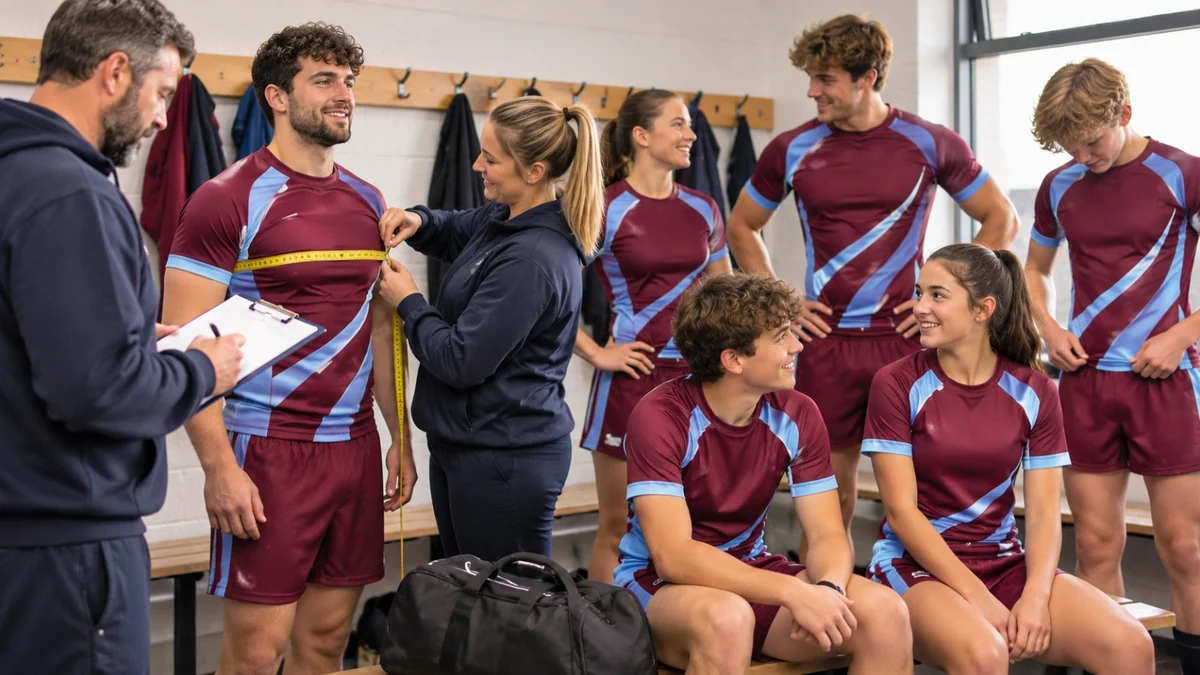
Keeping one design across the men’s, women’s and junior sections is the hardest part of rugby kits for amateur clubs, and it is the part that makes a club look like one club.
Design and Branding Checklist
A kit looks good from the touchline when the design is simple and the details are right.
- Colours: give your supplier Pantone or hex codes, not a screenshot.
- Logos and sponsors: send vector files such as AI, EPS, SVG or PDF. A JPEG or PNG loses sharpness in print.
- Names and numbers: use strong contrast and a clear font, and keep busy patterns away from the number.
- Colour clashes: since January 2025, World Rugby has restricted some colour combinations at its own events to help players and fans with colour blindness. Your league may follow similar guidance, so check before you pick a second colour.
- The proof: review the mockup closely, get sponsors to sign it off, and ask how many revision rounds are included.
You only need a second kit if your league requires one or your colours clash with a regular opponent.
What Drives the Price
Prices for rugby kits for amateur clubs vary widely between suppliers, and the cheapest quote is rarely the cheapest kit once you count replacements. Compare like with like.
- Ask for itemised quotes. Shirts, shorts, socks, names, numbers and sponsor logos should each have their own line.
- Know what moves the total: construction, reinforced collars, design complexity, quantity, freight and import charges.
- Stage the order. Buy match kit now and training kit next season.
- Ask about sponsor logos. Some suppliers include them, others charge per placement.
- Pool orders. Joining with another section, or a nearby club, can lower the price per piece.
For our prices, send your details through the quote form. We usually reply with a price, MOQ and lead time within one working day.
Minimums: Local Print Shop or Manufacturer?
Local print shops often accept small orders, which suits a club replacing a handful of shirts. A manufacturer works best when the whole club orders at once.
For rugby kits for amateur clubs, our minimum is 50 pieces per design across all items and sizes.
A 25-player squad ordering jerseys and shorts already reaches it, and adding socks or a women’s section in the same design takes you well past it.
Ordering for several teams, a school group or a regional association? Our Bulk Rugby Uniforms and Wholesale Rugby Uniforms pages cover larger runs and private label.
Ordering From an Overseas Manufacturer
Buying direct can lower the price per piece, but you take on some jobs a local supplier would handle. Before paying anything, get clear answers to these questions:
- Can I see a sample? A physical sample or fabric swatch beats a screen every time.
- What is the proof process? You should get a digital proof before production, with a set number of revisions.
- What if the kit does not match the proof? Get the reprint or refund terms in writing before you pay a deposit.
- What are the payment terms? Ask about the deposit, the balance and cancellation.
- Who pays shipping and import costs? Import VAT in the UK and customs charges in the USA may apply. Rules change, so check current rates with your courier or tax authority.
Here is how an order with Sialwear runs. We send a free mockup, then a physical sample.
Bulk production takes 12 to 21 days after you approve it, and courier delivery to the UK or USA usually takes 3 to 7 working days.
Payment can be made by bank transfer, Western Union, MoneyGram or Remitly. To compare a premium range, see our Premium Rugby Uniforms.
When to Order
Domestic suppliers usually have their longest queues in the weeks before the season, which is exactly when most clubs order. Overseas orders add proofing, freight and customs on top.
For rugby kits for amateur clubs made overseas, a safe rule is to start 8 to 12 weeks before your first fixture. That leaves time for design changes and a delivery that runs a little late.
Looking After the Kit
Good care helps every jersey last longer. Follow the care label, and as a general rule:
- Wash in cold water, inside out.
- Skip bleach and fabric softener.
- Let one person launder the full set after each match, so colours fade evenly.
- Hand out care notes with the jerseys on day one.
Frequently Asked Questions
These are the questions committee members ask most about rugby kits for amateur clubs.
What is included in a rugby kit?
A jersey, shorts and socks make up the match kit. Players add their own boots and, ideally, a mouthguard. Clubs often add training tops, warm-ups and supporter wear later.
How much does a custom rugby kit cost?
It depends on construction, extras, quantity and delivery. Ask every supplier for an itemised quote, so you can compare shirt, shorts, socks and logos line by line.
What is Sialwear’s minimum order for rugby kit?
Fifty pieces per design, with jerseys, shorts and socks all counting toward it. One squad ordering jerseys and shorts usually reaches it.
How long does a custom rugby kit take?
With us, bulk production takes 12 to 21 days after sample approval, plus 3 to 7 working days for delivery. Start 8 to 12 weeks before your first fixture.
What fabric is best for rugby jerseys?
Performance polyester with reinforced stitching at the collar, shoulders and seams. A little elastane adds stretch and helps the jersey recover after tackles.
How should a rugby jersey fit?
Close enough that there is little loose fabric to grab, but free enough for full shoulder movement. The sleeve must reach at least halfway from the shoulder to the elbow.
Do we need separate women’s and junior sizes?
Yes. World Rugby calls female-cut kit essential for women’s teams, and juniors need their own size range.
What file format should our club logo be?
Vector formats such as AI, EPS, SVG or PDF give the cleanest print. If you only have a low resolution image, ask for it to be redrawn as a vector first.
Do we need a second kit?
Only if your league requires one or your colours clash with a regular opponent. Check the competition rules before you order.
How do we wash rugby kit?
Follow the care label. In general, wash cold and inside out, and avoid bleach and fabric softener.
Ready to Compare Options?
Choosing rugby kits for amateur clubs gets much easier once you have settled three things: your budget, your size list and your deadline.
Send your colours, vector logos and sizes through our quote form, and we will return a free mockup, a price and a timeline. You can also browse the full rugby uniforms range first.
Kitting out more than one sport? See our guides to custom ice hockey jerseys for teams, custom basketball uniforms, custom cricket uniforms and ordering custom football kits.
About this guide
Written by Hamasah Tayyaba at Sialwear International and reviewed by founder Muhammad Abdullah Hamas, who has worked on team sportswear orders for six years.
